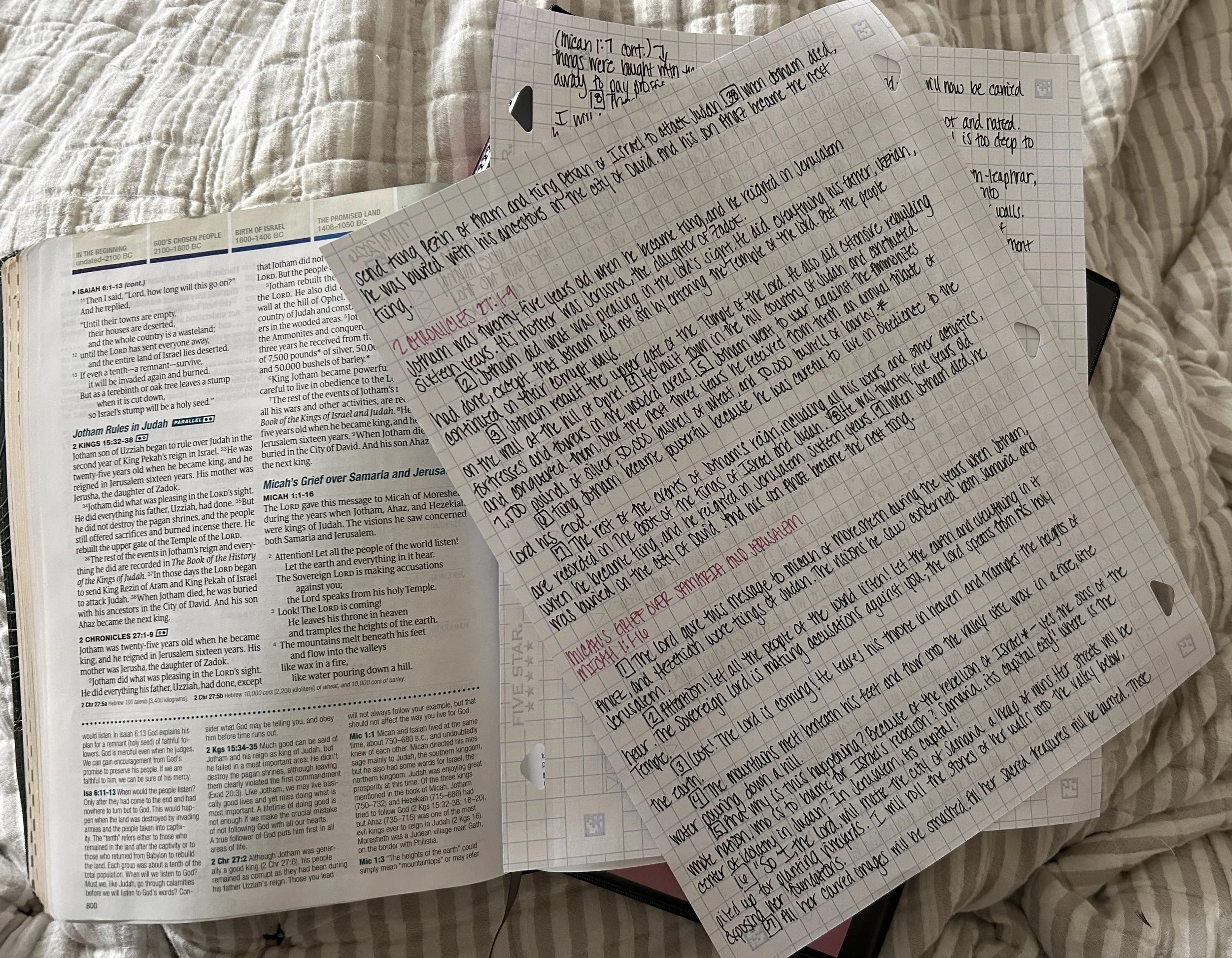
Scripture writing is the spiritual discipline of copying the Bible by hand, word for word. It’s a practice that goes back to ancient times, when scribes hand-copied important documents for preservation and distribution, including the Hebrew scriptures. Ezra and Baruch were scribes. (Some people consider Matthew a scribe, but he was actually a tax collector who wrote one of the Gospels. Not exactly the same thing, but important writing, nonetheless.)
Copying scripture by hand wasn’t limited to scribes. God required the kings of Israel to personally handwrite the law (either the book of Deuteronomy, or possibly the entire Torah, the first five books of the Hebrew Bible.) As scripture states:
18 “When he sits on the throne as king, he must copy for himself this body of instruction on a scroll in the presence of the Levitical priests. 19 He must always keep that copy with him and read it daily as long as he lives. That way he will learn to fear the Lord his God by obeying all the terms of these instructions and decrees. 20 This regular reading will prevent him from becoming proud and acting as if he is above his fellow citizens. It will also prevent him from turning away from these commands in the smallest way. And it will ensure that he and his descendants will reign for many generations in Israel.
~Deuteronomy 17:18-20 (NLT)
Today, several people have taken up this spiritual discipline, myself included. Social media hashtags like #WriteTheBibleByHand reveal a slew of believers who are hand-copying scripture as a part of their worship. Some are even writing the entire Bible. How inspirational is that?!
Why I Love This Method of Worship
I have engaged with scripture writing throughout my walk with Christ, though not as a consistent practice and not with an intentional purpose. Every once in a while I’d write out a verse while studying the Bible, or maybe add a quote for inspiration to a journal page. Until recently, I always stopped at writing out an entire chapter, though the desire was there. I felt it was too much to do, too time-consuming, and really just unnecessary. Was this Bible study, or was this homework?
But then I realized that was where my understanding and recollection of scripture often stopped. I could remember the parts of Bible studies I wrote out by hand years ago. I could go to the exact journal I wrote certain things down in and easily find what I was looking for because I remembered actually writing it and the color-coding system I used when I did it. (I also discovered how important archival ink is.) I also realized that I could remember the written exam I had to take for the sociology course I took more than twenty years ago. (Yes, back in the day you had to write your final paper in front of your professor with an actual pen and paper. No textbook or notes were allowed. Tell that to your AI. 🤣) Writing is how I actually learn, and science proves I’m not the only one.
Here are a few other reasons why I enjoy scripture writing.
1.) For Me, It Equals Humility
I have always loved writing. I don’t think I’ve ever loved anything more (outside of my child, of course) than creating something new on a fresh, clean sheet of paper. Some of my sweetest memories are sitting down on my mother’s bed and learning to write the alphabet while she graded papers after school. Writing has always been a part of who I am, and a gift I know God has blessed me with. Anyone who has ever known me will tell you that. It’s given me a career, allowed me to travel, and connected me with people I would never have dreamed in a million years I would meet.
And yet, copying scripture by hand has been much more fulfilling. As much as I want to dive into that creative mode and share my stories with the world for notoriety or profit, I’m just not in that season of life anymore. Scripture writing has proven to me that that’s okay. It has allowed me to accept the unexpected with no irritation or animosity. Even more, it continues to allow me to say, sometimes even out loud, “God, I’m putting aside my words to focus on Yours. I’m laying aside my thoughts, my literary dreams, my wants, and my desires, to slow down and meditate on YOU. What could me and a BIC (or a Staedtler pigment liner because I’m getting a tad bougie in my old age) ever create that could ever compare to Creation? You are not Creation, You are the CREATOR of Creation. What words could I ever record that could compare to THE WORD, which is YOU? YOU ARE THE WORD.” With this perspective, none of the other stuff really matters. For me, it’s humility, the first step of worship.
2.) It’s Accepted
As someone who has struggled with perfection and rejection in the past, scripture writing lets me know completely that God accepts me. It’s so intimate that it can’t be performative. Unlike church service, where so many spiritual wounds occur, no one is watching (outside of my son at times), so no one can judge. There are 820,980 words in the NLT, my translation of choice. The likelihood of writing every single one correctly the very first time is slim. Mistakes are inevitable, and guess what? I’m just as loved, forgiven, and blessed as I was before I pulled out correction tape. I can just keep going with no pressure from outside sources to write better. That, for me, has been very freeing.
3.) It Has Increased Prayer
Journaling itself is a therapeutic practice that many mental health professionals advocate for. It can really help process emotions and the things of the past that caused them. But I’ve found this isn’t always the most beneficial coping strategy for me.
As someone with the gift of words, journaling can be more powerful than intended, and not always in a good way. I learned to be careful with what I wrote, as journaling can yield unexpected turmoil. Writing emotions can cause you to get stuck in them. There was a time when every journal entry would have me teetering from sad, to mad, back to sad, and then mad again until I finally got tired of the back and forth and threw the entire pretty and expensive notebook away.
Scripture writing, on the other hand, has brought so much emotional elevation. I still have valid human reasons to be angry, but I’m much calmer and no longer seek vindication outside of the judgment I know God will give in His time. (Most days. Most… days. I’m a work-in-progress). Writing down the word of God instead of my emotions has brought so much peace because I pray about them more. Scripture writing has been so enjoyable that I don’t want to spend precious writing time on something so inconsistent as my feelings. I’d rather write the word of God. It doesn’t not change. It’s so much easier to give my mental struggles to the Lord in prayer and go on with my day than meditate on them for hours through writing. My life and home are much happier for it.
4.) It Increases Bible Reading
Scripture writing is also scripture reading. After all, how can you write it down if you don’t read it first? 😊 But aside from the initial reading, I’ve found that I’ve continued reading once my hand got tired. (Did I mention that will happen? It will.) I’ve also reread certain passages again and again when I normally wouldn’t have. And I’ve also rewritten passages more than once, slowing down to write things out while meditating on what is read and written. And I read much faster than I write. Once the focus is there, it’s easy to keep reading after I’ve finished writing for the day. I can’t quite pinpoint the reason why, but writing the Bible out makes reading it that much more enjoyable.
5.) It’s Not The Same as Bible Art Journaling
Scripture writing is a much easier and simpler process than Bible art journaling. Some creative people love Bible art journaling, but I’m not one to draw or paint, so I found it to be overwhelming when I went that route in the past. There is no wrong way to Bible art journal, and there is no wrong way to scripture write, either. I found relief in the simple process of using standard, inexpensive office supplies.
My Recent Scripture Writing
A few months ago I set out to intentionally write the book of Isaiah. It was my first headstrong, determined attempt to write an actual full book of the Bible (I tried Genesis a few times years ago and kept losing the notebooks. Yes, I can be that girl, too.) I chose Isaiah for a few reasons. The first is that it’s long and I’d feel accomplished when I finished. The second, and most important, is that I found Isaiah to be an intriguing book. There is a lot going on in it. It’s part narrative, part prophecy, part judgment (*gasp*), and there are parables, too. Isaiah is also one of the New Testament’s most quoted books. It’s heavily cross-referenced in the Gospels, and I’ve found in past readings that this particular book reveals God, His attributes, and His character in a way that I really want to study.
So I dug in, this time opting to use loose-leaf paper and a three-ring binder instead of a notebook. It’s been such a fun and fulfilling process, but I ran into a few hiccups. The initial issues were practical. The paper and pens I chose did not work well for long writing sessions, and I doubted they would hold up over time. My hand cramped constantly from pressing down too hard, pages ripped (again, writing hard), and ink constantly bled through. And even though I was remembering scripture, I wasn’t always understanding it. How did Isaiah receive his call in chapter 6 when he’d already been prophesying in chapters 1-5? And how was Ahaz, the grandson of Uzziah, already king in chapter 7 when his grandfather just died in chapter 6? Where’s the part about his father, Jotham? What is the timeline here? And why does it seem Isaiah is prophesying to the entire world when God sent him to Judah? Wait. One of the Black Pharaohs is involved in this, too?!?!! (See how much you catch when you write scripture out by hand? I didn’t notice any of that before!)
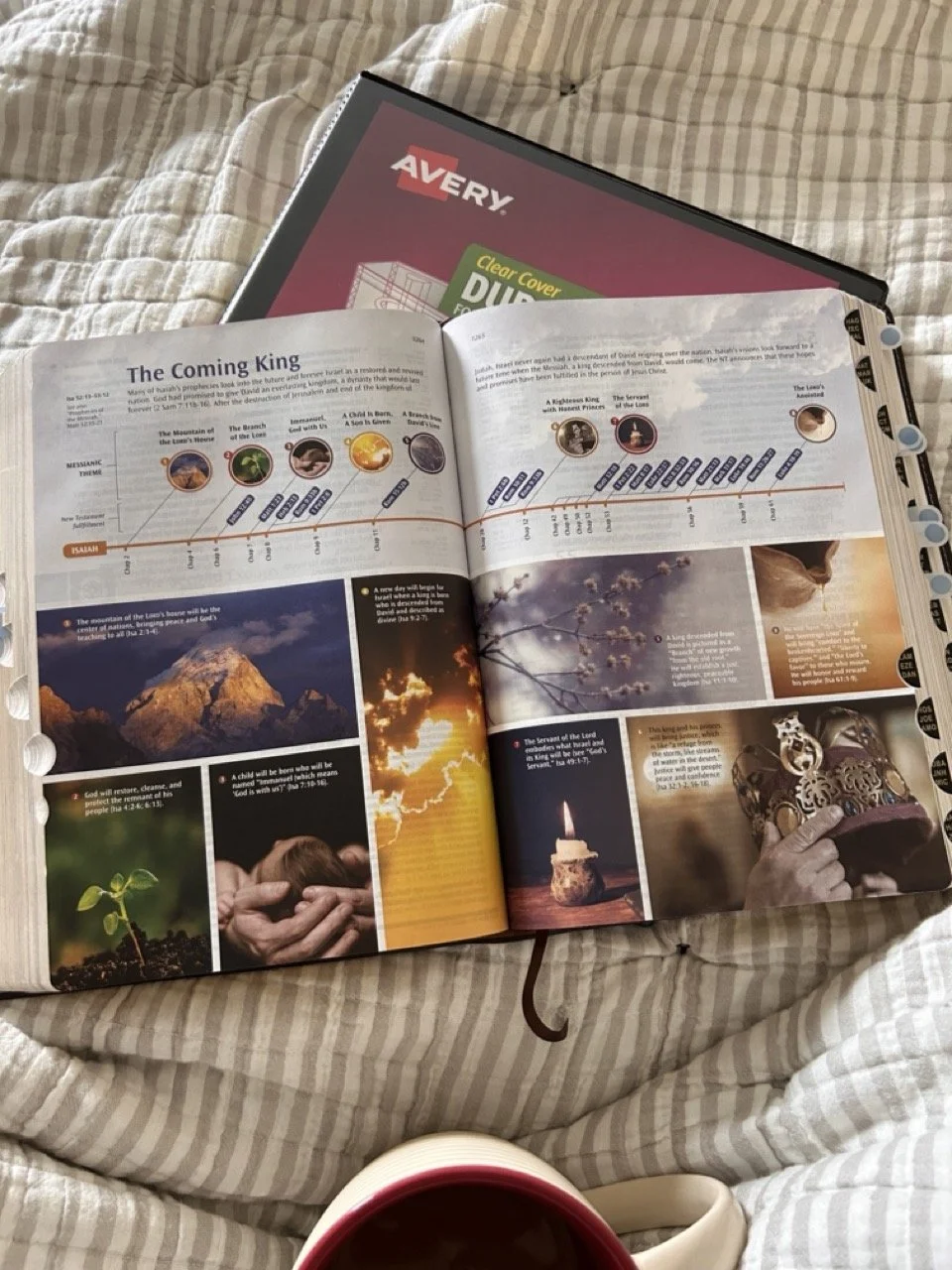
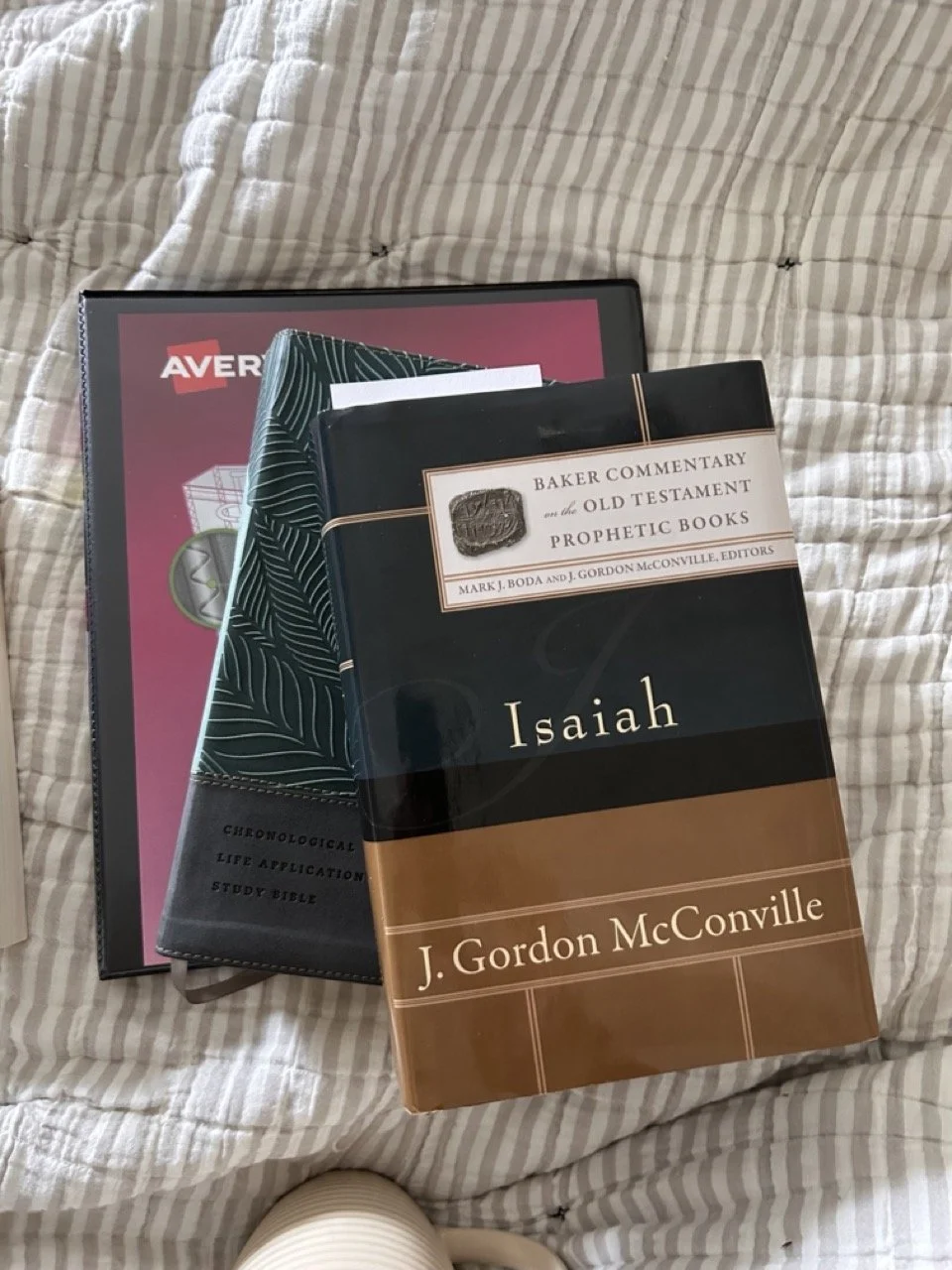
So, along with my supplies, I needed to change my approach. This led me to switch to my Chronological Life Application Study Bible. It doesn’t have the cross-references and full-page topical studies that the NLT Illustrated Study Bible I was initially using does, but it presents the Bible in the chronological order its events actually happened, which helps immensely with comprehension. (In it, chapter 6 comes before chapter 1 ☺️.) It’s also filled with study notes and articles that highlight the Jewishness of the Bible. (Sadly, many Bible resources neglect this reality.) A Bible timeline runs across the top of each page, and another in some margins to tell you what else is happening in the world during that time. For instance, a margin note reads “722 BC Assyria destroys Samaria” alongside Isaiah 28:1, Isaiah’s Message About Samaria.
When I look through the Chronological Bible, I see that a lot was happening during the time of Isaiah’s ministry. He ministered to a few kings, and the prophets Micah and Hosea were active during his time. This section of the Chronological Bible also includes portions of 2 Kings, 2 Chronicles, and selected psalms and proverbs. As I read, write, and study the book of Isaiah, I plan to include all of these parts, too.
Anyone want to join me?